Athletic Performance Toolbox

  • Strength Training
  • Speed and Agility
  • Administration
  • Injury Prevention/Rehabilitation
  • Professional Development
  • Archives

Creating Teammate Accountability

February 9, 2021 by

Have you ever coached a team that was talented but something was just missing and as a result it simply underperformed?

If the answer is no

… then either you haven’t been coaching long or you are one of the all-time great coaches.

The truth is a lot of teams fall short of expectations.

But why?

According to Dr. Cory Dobbs, Founder & President of The Academy for Sport Leadership, teams often become so focused on tasks and strategies and their commitment to the “team” begins to wane.

In the video clip below Dr. Dobbs discusses a case study he conducted with a team that was underperforming.

He shares the process he used to help them develop teammate accountability and become a more successful team that was focused on transformation, relationships, and harmony.

EXCLUSIVE: Click here for a FREE and limited time download of 10 more top articles from Dr. Cory Dobbs!


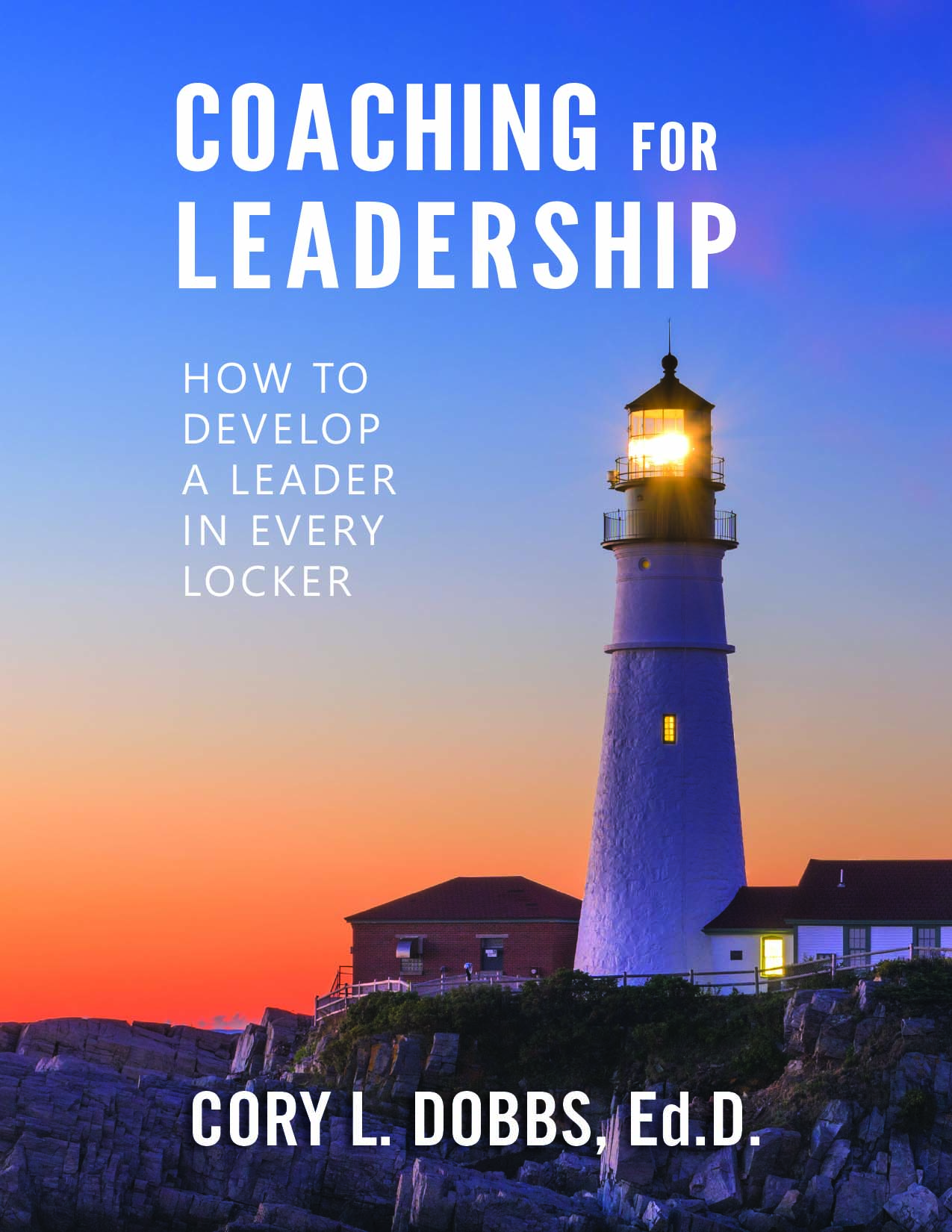
If you are a coach that is interested in the new science of leadership, teamwork, and teambuilding then you will want to check out Dr. Dobbs’s new masterclass: Coaching for Leadership.

In this groundbreaking course he shares his 3 Big Ideas:

  • A Leader in Every Locker
  • Coaching for Leadership
  • Teamwork Intelligence

*Athletic Performance Toolbox subscribers: Use coupon code “Toolbox25” to receive a 25% discount on the course at checkout here: Coaching for Leadership Masterclass*

Filed Under: leadership

Three Reasons Every Coach Needs a Mentor

February 2, 2021 by

Submitted by Dr. Cory Dobbs of The Academy for Sport Leadership. Dr. Dobbs is a regular contributor on coaching for leadership to The Coaching Toolbox.

Three Reasons Every Coach Needs a Mentor

Most coaches enter the profession with a vision on building a career.  Simply stated, anyone who is building a career will need help along the way. Experienced coaches, current and former, can serve effectively as mentors.  But a mentor needn’t be an ex-coach.  Sometimes the ex-coach as mentor can undermine growth and development by spending too much time on “this is how I handled it.”  All coaches can benefit from the wisdom and insight of others.  The energy and growth from relevant learning interactions can be a career game-changer.  Here are three important contributions that mentor relationships can provide:

REFLECTION
Learning from others further down the career road can be intimidating at first.  Yet, what feels like a big deal initially, may not be a big deal in the larger scheme of things. It’s important to know what to sweat and what to forget–when it’s okay to let something roll off your back and when you should stop and reflect more deeply. Great mentors have a better view of the broad landscape. Effective mentors excel at asking questions, specifically the types of questions that lead you to reflect on your performance, behavior, and goals as well has how to learn from your mistakes and successes.

PERSPECTIVE.
Mentors can help you make sense of your current situation; the small things as well as developing expertise from your experiences.  They don’t tell you what to do.  Instead they use questions to teach you how to think constructively on your own. In the process, they help you realign your perspective with the reality of the situation, to provide you the smoothest, most natural path forward in a way that is authentic to who you are.

EXCLUSIVE: Click here for a FREE and limited time download of 10 more top articles from Dr. Cory Dobbs!


ENCOURAGEMENT
There is an old saying that “nothing succeeds like success.” This means success bread success, that you have a better chance of being successful if you’re successful.  This is only partly true. We may gain confidence from our successes, but it’s our failures that develop our leadership muscle and offer the most powerful insights.  When you are expected to learn from your mistakes, it’s important to be able to view that process in a positive light–to see how valuable and rich hard-won lessons can be.  Every coach needs positive energy to move forward in their career. An effective mentor will help you build self-confidence step-by-step, through victory and defeat, success and failure, and all the challenges that emerge along your coaching journey.

Dr. Cory Dobbs is an accomplished researcher of human performance–a relentless investigator of team building and leadership behavior.  A skilled researcher, Cory actively engages the process of naturalistic inquiry seeking in-depth understanding of social phenomena such as leadership and team building in their natural setting.  A “teamologist,” Dr. Dobbs is an author, speaker, teacher, trainer and a consultant.

Cory is the Founder & President of The Academy for Sport Leadership. A former basketball coach, Cory’s coaching background includes experience at the NCAA DII, NJCAA, and high school levels of competition. Cory has worked with collegiate athletic programs and high schools teaching leadership and team building as a part of the sports experience and education process.

“Tell me and I’ll forget. Show me and I may remember. Involve me and I will care.” -Your Student-Athlete The world of coaching is changing. In Coaching for Leadership you’ll discover the foundations for designing, building, and sustaining a leadership focused culture for building a high-performance team. To find out more about and order Sport Leadership Books authored by Dr. Dobbs including Coaching for Leadership, click this link: The Academy for Sport Leadership Books

Filed Under: leadership

Yesterday Is Deceiving 

February 2, 2021 by

Dr. Cory Dobbs
The Academy for Sport Leadership

In an essay titled “Good Guys Finish First (Sometimes),” Andrew Bagnato told the following story:

Following a rags-to-riches season that led them to the Rose Bowl—their first in decades—Northwestern University’s Wildcats met with coach Gary Barnett for the opening of spring training.

As players found their seats, Barnett announced that he was going to hand out awards that many Wildcats had earned in 1995.  Some players exchanged glances.  Barnett does not normally dwell on the past.  But as the coach continued to call players forward and handed them placards proclaiming their achievements, they were cheered on by their teammates.

One of the other coaches gave Barnett a placard representing his 17 national coach of the year awards.  Then, as the applause subsided, Barnett walked to a trash can marked “1995.”  He took an admiring glance at his placard, then dumped it in the can.

EXCLUSIVE: Click here for a FREE and limited time download of 10 more top articles from Dr. Cory Dobbs!


In the silence that followed, one by one, the team’s stars dumped their placards on top of Barnett’s.  Barnett had shouted a message without uttering a word.  ‘What you did in 1995 was terrific, lads.  But look at the calendar: It’s 1996.’

Teachable Point of view: It’s dangerous to rest on our past successes.

New to the Second Edition of Coaching for Leadership!

We are pleased to announce a new chapter to the second edition of the best-selling Coaching for Leadership. The chapter, The Big Shift: Unlock Your Team’s Potential by Creating Player-Led Teambuilding, connects the previous edition of this book to its origin, as well as to the future of team sports.

The new chapter sets forth a practical and applicable agenda for change and improvement. The reader is introduced to seven vital elements of change; seven shifts of traditional mental models that lead to the new core principles necessary for creating a player-led team culture. Click here for more information about Coaching for Leadership

About Cory Dobbs, Ed.D.

Cory Dobbs is the founder of The Academy for Sport Leadership and a nationally recognized thought leader in the areas of leadership and team building.  Cory is an accomplished researcher of human experience. Cory engages in naturalistic inquiry seeking in-depth understanding of social phenomena within their natural setting.

A college basketball coach, Cory’s coaching background includes experience at the NCAA DII, NJCAA, and high school levels of competition.  After a decade of research and development Cory unleashed the groundbreaking Teamwork Intelligence program for student-athletics. Teamwork Intelligence illuminates the process of designing an elite team by using the 20 principles and concepts along with the 8 roles of a team player he’s uncovered while performing research.

Cory has worked with professional athletes, collegiate athletic programs, and high schools teaching leadership and team building as a part of the sports experience and education process.  As a consultant and trainer Dr. Dobbs has worked with Fortune 500 organizations such as American Express, Honeywell, and Avnet, as well as medium and small businesses. Dr. Dobbs taught leadership and organizational change at Northern Arizona University, Ohio University, and Grand Canyon University.

Filed Under: leadership

Sandglass Sport Success

January 26, 2021 by

This article was provided by Bjorn Galjaardt

Okay, a catchy phrase for something that might actually be a double pyramid model. However, time is of the essence and clubs, coaches, athletes, parents or caretakers and stakeholders can act now. The Sandglass Sport Success model is a blueprint that poses challenges of ‘participation’, ‘early specialisation’ and ‘high-performance’. In fact, in various sports, people find the same challenges and opportunities but may find friction in or from certain levels of the ‘sandglass’. The sandglass works from a broad FUNdamental base to a narrow high-performance climax, that eventually will mirror success. Interested? Let me take you through a journey of a blueprint in sport success.

First pyramid:
The first pyramid is based on the basics and needs of the participants. It is like a combination of Maslow’s hierarchy of needs and Balyi Long-Term-Development-Model, but then for all sport needs involved! From associations to clubs and from grassroots to high-performance interests. Active Start.

1. Statistics shown that most participants join an introduction program, whether it is through the school, club, association or similar. On average, globally, around the age of 8 years old. Some have gone through ‘mandatory’ programs (e.g. learn-to-swim), while others try sport based activities for the first time. Some will join at a later age as they may transition from other sports (e.g. swimming to water polo), like to try something new or it is part of a (curriculum) activity. Fun is the main driver: FUNdamentals

2. Other or the same participants either transition to the next phase or begin here. The second most important layer. In both layers, there could be some sort of competitive component involved, but the majority want to play the sport with friends, try something new or really want to learn more about the sport. Learn to train.

3. Phase 3 is where the ‘fun’ starts to form a different dimension. Training starts to get serious for some. Perhaps there is an appetite for more, perhaps the club has a history of being a more performance driven club, perhaps there are other reasons. The main idea is to offer multiple levels for multiple participants, which shall now be called players. This base layer of phase, or stage, 1, 2 a 3 is needed to provide adequate opportunities for all players involved. Whether it is a once in a week game with a BBQ after or 5 times a week training with an A division team. If we lose those crucial ‘hot’ levels (hence the colours red, orange and yellow), there will be no phases or stages after this. High-Performance is bound to those first 3 crucial levels. Train to Train.

4. As the pyramid layer shrinks, the level of players become thinner. Players shall now be called athletes, whether they are emerging or close to elite. They play representative and they want to continue to do well. Some are happy to already perform on this level, others want more. Most of them specialise into this sport alone, others may drop out and it is crucial to capture them and nurture them on the level that they feel valued and welcome. Some may have educational sponsorships or still depend on parents or stakeholders. Train to compete.

5. This is the level with the least athletes. The financial structure depends on professional sponsors or government support. The quality is assumed to be higher and for that matter, perhaps high key performance indicators are on stake. Train to win.

Second pyramid.
The reflection of the first pyramid, or better the expansion.

6. Coaches, athletes or coordinators and managers who have gone through phases or stages 3, 4 or 5 and are a current or past identified role models, could be utilised for those levels to inspire those that are close to that same level. Learn from their experiences and share their stories. Sure, when high stake medals were won this would leverage the strength of this phase. However, there are many examples of successful club programs and sponsor packages that others have never seen, just because it was not shared with the right people. Who in your club has a success story that people could learn from? Perhaps a community members’ father, who won the Football Premiers… Share to perform.

7. All members from all levels can inspire, not just your top performers. There are great coaches out there who never represented any country but touched many lives and build a club. Past players who actually never thought of doing something for the club or program, because they perhaps never been asked, therefore never had considered it. Who in your club or program knows a person that perhaps has an interest to inspire a current or next generation? Teachers can introduce water polo into schools or schools into your water polo program. Share to inspire.

8. People who currently play or have transitioned from playing and are in roles that could have a positive influence on your sport. Health and wellbeing is a hot item currently with more attention to it than a few decades ago. Develop a think tank with administrators in the sport area to evaluate competition, programs for clubs and schools and see what you can offer them. This may as well open connections and create transparency, perhaps there is even a need that was not identified before. Now maybe financial benefits are mutual! Inspire to develop.

9. By showcasing the sport there needs to be mutual benefits as mentioned in phase 8. This can be done by a combination of previous phases. Some benefits may run short term, other long term. To establish improvement a holistic approach needs to be considered. Created to be improve for the next few years if not for the next generations. Inspire to improve.

10. Once all stages or phases have been experienced, the reach to the community will be the foundation stage for the outreach of the sport. The sandglass can be built on again with stage or phase 1. New or current participants will become players, athletes and hopefully stay involved for life. Becoming new administrators, coaches, referees, sponsors and passionate supporters. Leaving a legacy. Active for Life.

SUMMARY: THE SUNGLASS SPORT SUCCESS MODEL

As time slips by, we would hope that the levels of support and interest in your sport will always continue. The reality is that time seems to runs out. New rules, organisational structures, players moving clubs, athletes dropping out and participants choosing different sports. What if we could improve the current structure and leverage of what we are doing now? Often the perception is that this comes at a price, e.g. winning medals, attracting good players, etc. This is not necessary the truth. What we need to do is stop early specialisation, keep pushing youngsters to limits that only others would like to see of them, and stop pointing fingers to above and below. Use what we have to keep a sport we all love. That does not mean that we cannot be competitive; we just do not need (the same level of) competition for everyone. We do not need to specialise and train 20 plus hours a week in an early stage of life. We only need to provide the right opportunity. There are many factors like different maturity ages, social-economic impact, etc. and some of these factors can be used to benefit and support the first pyramid effects.

What we need to do is leverage what we have done; evaluate, anticipate and generate in order to execute. This means a shared responsibility, ownership of tasks and goals as well as transparency and working together. This starts within the capacity and placing of your phase or stage in the pyramid. High-performance cannot be sustainable on it is own, but without high-performance we also miss the pathways and need for the few who can be role models and use our sport as a promotion. Adapt to trends in sport, but with a feel what the community wants and what the sport needs. Let us use the Sandglass Sport Success model in order to keep building and improve our sport. Leave a legacy and turn the sandglass with the ease.

AUTHOR

Bjorn Galjaardt (B.ed) studying Master of Sports Coaching with 12+ years coaching and managing experience from grassroots to elite level. Held roles in program management and currently delivering online and in person performance services at Blended Performances.

Filed Under: professional develpoment

Seven Coaches, one answer: Person beyond the Player

January 26, 2021 by

This article is contributed by Bjorn Galjaardt

Does coaching means to achieve results and reach set targets? Coaching to win! However, this is only one perceived idea on coaching. True, there are goals that need to be achieved. The reality is that most coaches view coaching as a complex process that contributes to multiple facets of the individual and thus team.

Filled with curiosity about the concept of coaching, I picked the brains of seven highly regarded coaches from various backgrounds and industries. Posing the difficult question: ‘Can you describe in a few sentences what coaching means to you’?

Mrs. Gonny Farley-Reijnen. Lecturer Sport Institute CIOS | Culture Coach Royal Dutch Baseball and Softball Association. Coaching for me is creating a positive performance culture. One in which everyone knows their tasks and responsibilities. A coach is there to lead everyone to the right behaviour, ensuring that they continue to grow, have the freedom to succeed and have relationships that they value. This applies to the individual as well for the team. Embrace the process!

Mr. Jay Ellis. Sports Performance / Business Academic | Academic Lecturer Australian College of Physical Education | High-Performance Consultant. My single thought: Coaching for me is all about people skills. Understanding the athlete is vital! Our job as coaches should be to develop the person before the athlete (the second will come).

Mr. Simon Daley. Head Water Polo Coach | Founder of Academy Water Polo & Goggle Project. It is the ‘self-felt joy’ of being given an opportunity of unlocking a player’s potential, so as to maximise their own performance towards success. This not only involves their on-field skill requirements but having a guide to their off-field achievements post their sporting career.

Ms. Martine Tobe. Director at Children’s Perspective Foundation | Founder Lifebook for You(th) | Board member FICE Netherlands. For me coaching is especially focussed and designed to provide a perspective for the future. Asking questions and providing a mirror to allow for self-reflection. Using positive psychology and recognising traits together to further develop. The coaching basis is providing attention to ‘growth’ possibilities. I like to focus on the qualities and contribute to a positive feeling in doing so.

Mr. Grant Jenkins. Performance Coach | Presenter | Educator | Coaching Athletes | Accelerating careers | Developing businesses. To improve the mindset of the person I am working with so they can achieve their long-term goals in life.

Mr. Bob Beusekom. Executive Director at The Executive Nomad | CFO Bright Zebra | Board member True (Family Planning Queensland). “Beat your yester self”. My view is that coaching style leaders do not only focus on the role performance of their staff. They also aim to develop their staff’s ‘self’, ideally considering the whole person, in a safe environment, on a plate of trust and respect, with a sauce of authenticity and vulnerability. Through coaching, as a leader, you can help reduce blind spots and self-limiting beliefs, giving your staff confidence and insight in their ‘selves’, purpose, and roles in life.

Mrs. Anna Wood. Women’s High-Performance Coach Australian Canoeing | Musculoskeletal and Sports Physiotherapist. As a HP coach I need to know my athletes’ goals, dreams and beliefs, their doubts and fears, basically what makes them tick… Between coach – athlete – team we strive for a foundation of trust and respect with room for individuality. If this foundation is firmly embedded into our culture, we are able to provide honest and constructive feedback, achieve full commitment of every team member and hold each other accountable. I believe this is the pathway to success.

SUMMARY:

Coaching as described by the business, education and sports coaches above is focused on ‘the person beyond the player’. Goals are merely milestones to provide an indication in the process of coaching performance. Whether it is improvement in one context, say technical aspects, there are other contexts like life skills, study/work balance and so on. Coaching is a meticulous process that is continuously managed and reviewed. A portfolio of this perspective on coaching will include a range of foundational strategies. For example, focus on personal development, growth mindset, and creativity. Furthermore, allowing room for self-reflection, mutual respect and understanding. Coaching comprises an arsenal of believes, methods and strategies to create a culture of trust and commitment for people to flourish. Coaching the person, equals coaching the process: ‘Fuelling the engine for optimised coaching’.

Special thanks goes out to the contributing coaches for this article.

AUTHOR

Bjorn Galjaardt (B.ed) studying a Master of Sports Coaching with a focus on Olympic education. He has 12+ years coaching and management experience from grassroots to elite sports level. Currently delivering online and in person performance services at Blended Performances.

Filed Under: professional develpoment

  • « Previous Page
  • 1
  • 2
  • 3
  • 4
  • 5
  • …
  • 40
  • Next Page »

 Want exclusive Athletic Performance insights?

    Join the newsletter!

 More Knowledge. More Impact. Let's go to work!

  • Twitter
  • Facebook
  • linkedin

© Copyright 2025 Athletic Performance Toolbox

Design by BuzzworthyBasketballMarketing.com

Privacy Policy

Grab your copy of the exclusive download here!

Enter your email below to get your ebook!

x