Athletic Performance Toolbox

  • Strength Training
  • Speed and Agility
  • Administration
  • Injury Prevention/Rehabilitation
  • Professional Development
  • Archives

Cossack Squats

January 30, 2018 by

This article was provided by Training-Conditioning

Did you know there is a type of squat that can better prepare your athletes for competition? It’s called the Cossack squat, and it can help increase athletes’ strength and flexibility through a full range of motion.

In a blog for DeFranco’s Training, Joe DeFranco, CSCS, NASM-CPT, explains why going beyond the “regular” squat is important for athletes. He writes that sports are played in three dimensions—think about the volleyball player who lunges to the left for a dig or the baseball player who stretches off the plate to snag an out. While still useful, DeFranco points out that traditional squats don’t completely prepare athletes for these types of motions, increasing their chances of injury, especially groin pulls.

The Cossack squat adds this third dimension. In a blog for TrainHeroic, Mike Dewar, CSCS, NSCAS, USAWL2, explains that this exercise enhances hip, knee, and ankle mobility while also strengthening the glutes. This will not only help athletes move properly during competition, but will also allow for better movement in other squatting exercises as well.

“Unlike the side lunge, this squat variation really forces an athlete to work the hip throughout the entirety of the end range, which is important for runners, wrestlers, and other full range of motion athletes,” writes Dewar.

But the benefits of the Cossack squat extend even further. According to a blog by Strength and Flexibility Coach Angie Fliehser, this squat not only stretches the hamstrings and hips, but it also helps to strengthen the core and improve balance—all of which are important to help athletes play their best.

As with any exercise, it is important that your athletes learn the correct technique in order to decrease the chances of injury and to gain every benefit. Here are the steps to correctly carrying out the Cossack squat, laid out by Fliehser:

  1. Begin with a wide stance.
  2. Keep the leg you are squatting over aligned from hip to knee and down to the foot.
  3. Keep the foot on this side flat on the ground.
  4. Point your other toe upward with the heel down, rotate at the hip so your knee is pointing straight up.
  5. Sit down into your hips, keeping your back flat.
  6. Push up to standing through the planted foot, distributing the weight evenly.

When implementing the Cossack squat, Dewar suggests starting with 10 sets per leg. To further increase strength and hypertrophy, he also recommends adding weight for 3-5 reps, such as a kettlebell. Other variations include using straps for assistance or using a barbell to add weight. However, this exercise can also be done with just bodyweight, which according to Dewar, makes it perfect for warm-ups or even as an active recovery movement.

To see the Cossack squat in motion, check out this video from Onnit Academy.

The YouTube video has sound, so please make sure that your volume is turned up and that you have access to the site. Note some schools block access to YouTube.

Filed Under: strength training

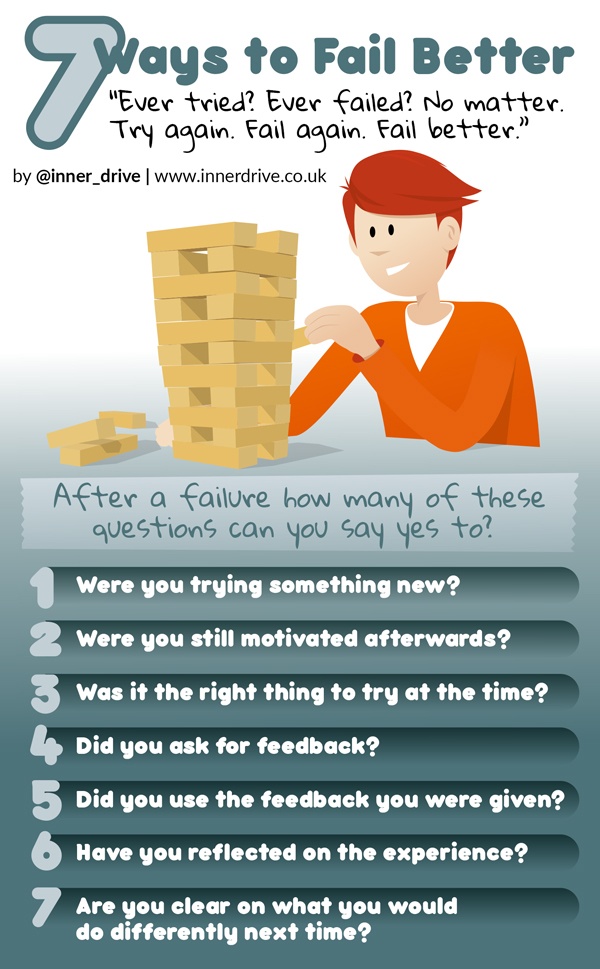
7 Ways to Fail Better

January 27, 2018 by

How can we teach our athletes and ourselves to fail better?Learning to fail better can greatly improve one’s growth and development.


Editor’s Note from Brian: I believe that these 7 lessons apply in athletics when athletes or coaches are working to acquire new skills or improve existing ones as well as in academics. 

How well do your students fail? Poet Samuel Beckett once said, “Ever tried. Ever failed. No matter. Try Again. Fail again. Fail better.” Turns out he was sort of right, as research by psychologists over the past two decades has found that the way you explain your failures can have a profound impact on your future behaviour.

Research from sport suggests that if athletes attribute failure to permanent causes instead of temporary ones, and if they overgeneralise instead of being specific, it can lead to them feeling less confident, more anxious and performing worse in the future.

Could this be applied in schools? Students have many highs and lows over the course of the year. Failure at some stage is inevitable.  Some students see their failures as permanent (“I will never be good at art” vs. “I am struggling in art at the moment”), and they overgeneralise (“I don’t like maths” vs. “I don’t like algebra”).

To combat this, some schools have started running a ‘failure week’ to help promote the importance of taking risks, learning from mistakes, and reducing students’ fear of failure.  Others are incorporating these principles regularly into PHSE lessons and enrichment days.

HOW TO FAIL BETTER

So how can we help students fail better? It is important to note that failing better is different from aiming to fail. The former focuses on learning and development; the latter suggests low expectations and lack of effort (which is the opposite mindset of what we promote). Students ‘fail better’ if they can answer yes to these questions…

Were they trying something new?

Being open and enthusiastic about new and challenging situations is a key characteristic of having a growth mindset. We want to help students shift away from focusing on ‘proving myself’ and more towards ‘improving myself’.

The teenage years offer a unique window of self-discovery and improving self-awareness. It can be when people discover what they are passionate about. Part of this process is trying new things, experimenting, and finding out what one’s strengths/weaknesses might be. Failures are integral to this. Helping students understand this can help aid their learning and development.

Were they still motivated after the setback?

Research on teenagers has found that those who are motivated by learning and mastering a subject, compared to those who are extrinsically motivated by rewards, display higher levels of emotional control before an exam, have higher levels of confidence, and achieve better academic performance.

Doing well at school is more akin to a marathon, rather than a sprint. Motivation needs to be robust and durable in order to aid resilience. Focusing on improvement, on learning, and on getting better should ensure that this happens.

Was it the right thing to try at the time?

It is easy for students to judge how good their decisions are based on the outcome (i.e. if it ended up well, it was a good decision; if it ended up badly, it was a bad one). This is a mistake, as sometimes the result may be down to randomness, luck, or a million other factors. This can lead to people throwing the baby out with the bath water.

Statistician Nate Silver, the only man in America who correctly predicted how each of the 50 states would vote in the 2012 Presidential election, states that instead of judging decisions based on the eventual outcome, it is far better to judge them based on the information you had at the time.

If students make the best decision possible from the information available, then perhaps the mistake was down to execution of the skill and not the thought process going into it. This is an important distinction to make, as it can help identify which part of the process to target for improvement next time.

Did they ask for feedback (and then use it)?

There is a great quote that says, “Real failure is a man who has blundered, but not cashed in on the experience.” If students are going to suffer from setbacks (and it is a certainty that they will at some stage), then there is a three-part way to ensure they learn the most from it.

First is the act of asking for feedback. This is a great behaviour to praise, as it is the behaviour you want them repeat after future failures. Second is being open to the feedback. This is a fundamental part of learning. If students feel that they are being judged or attacked, it is unlikely that they will heed the feedback, no matter how helpful. Third is getting them to action the feedback. It is not enough to have good intentions; behaviour change comes from doing, not just thinking about it.

Did they reflect on the experience and know what they would do differently?

Setbacks can aid the learning process, but only if the person experiencing it takes the time to reflect on what has happened and as a result, is clear on what they would do differently next time. Otherwise, it is likely that they will repeat the same mistakes again and again in the future. It is ok to make mistakes. To keep making the same one is criminal.

Having students ask themselves ‘what would I do differently next time?’ is a great question for two reasons. First, it stops them dwelling on the past, which can reduce student stress. Second, it gives them a sense of control over the situation, which will help boost their confidence and motivation when moving forward into the future.

FINAL THOUGHT

We all want the students we work with to be successful; however, it would be foolish to think that they will never fail. We don’t want students to fail more, but if (and when) some of them do fail, we want them to fail better. Helping them fail better isn’t negative; if anything, it may be one of the most positive skills we could teach them.

About Inner Drive

InnerDrive is a mental skills training company coveing the traditional areas of sports psychology and mindset training.

Their work covers the traditional areas of performance psychology, sports psychology and neuroscience. They work with over 120 schools in England and last year worked with over 25,000 students, teachers and parents.

The company is led by Edward Watson, a retired Army major and Bradley Busch, a HCPC registered psychologist.

Filed Under: professional develpoment

AgilityTraining: Cone Drills

January 20, 2018 by

This article was provided by Training-Conditioning

Have you found that while your athletes are consistently getting stronger, they are not gaining agility? If so, you might want to consider adding footwork and running drills to their workouts.

Doing this will not only make your athletes faster, but also give them more power and endurance. When implementing agility drills, one of the best instruments to use is a cone.

Affordable and easy to transport, cones can add variety to any workout. Unfortunately, some coaches associate cone drills with football, and many of the exercises actually have football in their name. However, Matt Rhodes, Head of Strength and Conditioning at Morehead State, found that none of them are truly sport-specific. After four weeks of applying these drills to the workouts of the softball team at Morehead, both players and coaches noticed great improvement in how the athletes looked and moved.

“My advice: no matter what sport you work with find some football cone drills and teach your athletes how to do them,” Rhodes wrote in an article for elitefts. “In my opinion, no drills like this are sport-specific (I said football because football has thousands of cone drills to choose from).  They are simply drills that get the athletes moving and changing direction in a variety of different ways.”

In an article for Livestrong, personal trainer Joe King echoes the sentiment that these drills can help athletes adapt to the fast-paced environment of any sport. According to King, having athletes run to cones in different patterns can increase their speed, as they are training the skeletal muscles to contract quickly. While building speed, cone drills can also help athletes increase their balance and coordination.

“By setting up a series of cones in patterns that require a lot of forward, backward and lateral body movements, you can increase agility,” writes King. “In sports competitions, this means that you may be able to move more efficiently across the playing field.”

Beyond speed and agility, cone drills can also make your athletes more explosive. This can be done by making sure athletes are pushing off of each turn as hard as possible or even having them jump over cones at progressively higher platforms. And while it may seem like these drills are aimed only towards short bursts of energy, they can also help athletes build endurance.

“Having muscular and cardiovascular endurance can help you maintain a high level of intensity over a long duration, such as during a sporting event,” writes King. “You can increase both your muscular endurance and cardiovascular endurance by interval training with cones. Interval training involves setting up cones progressively further apart from one another and running back and forth between them with little to no rest in between.”

Along with interval training, there are a plethora of cone drills that can be used to improve athlete performance. Here are two explained by Jay Dawes, PhD, CSCS*D, NSCA-CPT*D, FNSCA, in an article for the National Strength and Conditioning Association:

Quickness Box

This drill is good for improving quickness in confined spaces. It should be done for approximately 10 seconds per set, and athletes should do two or three sets.

  1. Set up four cones in a square with sides approximately 6-10 feet long.
  2. Number the cones one through four.
  3. The athlete assumes an athletic position in the center of the box.
  4. Specify whether the athlete will touch each cone with a specific hand or just using the closest one.
  5. With either a hand signal or out loud, the coach will give the athlete a number.
  6. The athlete will run, backpedal, or shuffle to the specified cone and touch it.
  7. The athlete sprints back to the starting position.
  8. Repeat.

Y-Drill

This drill will help athletes learn how to rapidly adjust stride and foot placement to change into other movement patterns.

  1. Set up four cones in a the shape of a Y. The two cones at the top of the Y and the base cone should be placed about 10 yards from the middle cone.
  2. The cones should be numbered as follows: base cone—1, middle cone—2, top cones—3 & 4.
  3. The coach stands in front of cone 2, inside the V at the top of the Y.
  4. The athlete assumes a sport-specific position at cone 1.
  5. At the coach’s designated signal, the athlete sprints to cone 2.
  6. The coach then directs the athlete to which of the three other cones he or she should sprint to next.
  7. Coaches can modify this drill by having athletes backpedal or side shuffle to the designated cone.

To see five other cone drills in action, check out this video from Profect Sports

The YouTube video below has sound, so please make sure your volume is turned up and that you have access to the site. Note some schools block access to YouTube


Filed Under: speed and agility

Working with Injured Athletes

January 14, 2018 by

How do you work with athletes that are injured and out of competition and practice for extended periods of time? In addition to rehabbing the injured body part, there are other goals that can be accomplished during this time away from competition and practice.

In the video clip below Fred Hale, assistant strength and conditioning coach at Eastern Michigan University, discusses his approach to dealing with injured athletes.

Coach Hale begins by discussing how difficult it is for injured athletes. Many of them have worked very hard in preparation for the season and when an  injury occurs, they can have a tough time. Many times the injury causes them to miss practice and games. In some cases the athlete is devastated to find out that they will miss the entire season.

Many of these individuals identify themselves as athletes. When that is taken away from them it can be very difficult for them. They will obviously have physical limitations that can be tough to handle. They also may have some things to deal with mentally. They may be depressed, angry, frustrated and might feel disconnected from the team. They might even exhibit changes in eating and study habits.

Many times it is the strength and conditioning/training staff that will be spending the most amount of time with injured athletes. Coach Hales states that it is important to show that you care and that this could be a time to “get really strong and comeback stronger than ever”

He begins by immediately testing, putting together a plan and setting goals. This is a time to do three things in addition to rehab:

  • Increase hypertrophy
  • Gain gtrength
  • Fix imbalances in non-injured areas

Coach Hale also discusses his workout structure and how the determine set/reps based on goals and Time Under Tension schemes

This clip is from Coach Hales presentation entitled  Coming From Within: Working with Injured Athletes at Glazier Athletic Performance Clinic. For more information about how to gain access to his entire presentation, as well as hundreds of other great clinic presentation, click the link Glazier Athletic Performance Clinics

The YouTube video below has audio, so please make sure that your volume is turned up and that you have access to the site. Note some schools block access to YouTube.


Filed Under: injury rehabilitation

Four Step Method to Success

January 11, 2018 by

This article was provided by  Coaches Network

By Patrick McHenry

One of the most challenging aspects of training high school athletes is balancing the needs of an entire team with individual players. Utilizing the Four Step Method provides a solution.

The Four Step Method covers these critical areas: testing, evaluating, setting goals, and developing a program. Below is a closer look at each one.

1. Testing refers to assessing the athletic levels of your team members. It identifies the strengths and weaknesses of student-athletes individually and as a team, and enables the coach to design a strength and conditioning program that is specific to the needs of each student-athlete.

The three recommended tests are the Vertical Jump, Pro-Agility Run, and 10-Yard Dash. Other tests that can be included are the Long Jump, the Medicine Ball Throw, and the Three Cone Drill. (You can find more detailed instructions on these tests in this previous article.) Note that these tests are for “power” sports, not endurance sports. They also fit into a combine style set up so I can perform multiple tests in a time efficient manner.

Testing should be performed at several different times:

• Before developing a training program

• To assess progress at regular intervals throughout training

• As a way to have your athletes compete against each other in the off season, which helps keep them motivated.

The great thing about performance testing is that you can see how well your athlete is progressing without undo stress and potential injury. Ask any professional strength coach how often they require their athletes to perform one rep maxes and they will say the same thing: NEVER. If a professional athlete gets hurt maxing, the coach will lose their job. The risk is too great.

There is no reason to risk an injury at the high school level by performing a one rep max. Many of our athletes have a training age of one to five years, which suggests their lifting technique may not be as high quality as a college or pro athlete. What about doing multi-rep maxes? A multi repetition maximum may be safer, but it will not give the same performance measure as we can get from a vertical jump, pro agility run, and 10-yard dash.

2. Evaluation entails analyzing the test results of each student-athlete and the team as a whole. This is a vital step so you know specifically what weaknesses each individual needs to work on and what weaknesses the team has. It will then help you design the most effective program.

After testing I have each athlete graph their results and then chart them so they can compare their scores to athletes who are the same age and gender from all over the county. I use the National Strength and Conditioning Association (NSCA.com) Performance Assessment package (free to members)

3. Goal Setting requires athletes and their coaches to identify a reasonable time or score to achieve within a certain time period. Setting performance goals allows coaches and student-athletes to have a focus point to strive for every time they come into a workout. This helps each athlete stay motivated to improve, not only individually but also for the team.

I like to talk to each athlete about goal-setting so they understand its importance. I explain how their lifting and work effort will help achieve their goals if they use the program correctly. Then each athlete has an opportunity to write up their own goals.

Goals should never be set too high or too low. They should be challenging, yet realistic, and allow for the student-athlete to see improvements each time they test. They should also be specific. “I want to improve my vertical jump” does not tell me much. “I want to improve my vertical jump by two inches before the end of the second term” would be a good goal.

A vital step in goal setting is to not only write down goals, but the steps for achieving them. For the athlete who wants to improve their vertical jump, steps might be: working on their cleans, focusing on their squat technique, and putting all their effort into plyometric days.

4. Program Design refers to the training regimen that the coach designs to help the student-athlete achieve his or her goals. Ultimately, effective training programs will result in an improvement in athletic performance.

The program should be designed (or modified) depending on the athlete’s goal. If an athlete is trying to improve their vertical jump, we will focus on cleans, jumps and squats, for example.

Before we start the lifting program, we make sure the athlete is using good technique. We check over the athlete’s knees to make sure they are positioned properly. We look at arm mechanics and assess if they are using their core fully and going through full range of motion. One area that is often overlooked is the deceleration (or eccentric) phase of a lift. We will go down slowly in the eccentric phase of the lift and then explode up in the concentric phase.

One note of caution is that eccentric loading will break the athlete down. So only do this in the off season. If an athlete wants to work on speed, we will use the same lifts and work on technique.


Patrick McHenry, CSCS*D, is the Director of Strength & Conditioning at Castle View (Colo.) High School. He has presented to sport coaches, strength coaches, and physical education teachers at state, national, and international conferences. He is the former Colorado state director for the NSCA, was the chairman for the NSCA High School Special Interest Group, and is currently on the NSCA Board of Directors and Coaching Performance Committee. 

Filed Under: administration

  • « Previous Page
  • 1
  • …
  • 12
  • 13
  • 14
  • 15
  • 16
  • …
  • 40
  • Next Page »
  • Twitter
  • Facebook
  • linkedin

© Copyright 2025 Athletic Performance Toolbox

Design by BuzzworthyBasketballMarketing.com

Privacy Policy