Athletic Performance Toolbox

  • Strength Training
  • Speed and Agility
  • Administration
  • Injury Prevention/Rehabilitation
  • Professional Development
  • Archives

Hip Dominant Exercises

February 17, 2018 by

This post was provided by Complete Track and Field.

Here are three Glute-ham Complex exercises that can add variation to your workouts. These exercises will work the posterior chain and help improve acceleration, and especially top speed, while helping to prevent injuries.

By Travis Hansen,

We are all more than likely well aware at this point that the posterior chain, Glute-Ham Complex, Backside, or whatever else you would like to call it, is absolutely critical in all areas of human performance. Success in everything from power lifting, Olympic lifting, bodybuilding, team sports, injury prevention-treatment, aesthetics, etc. automatically demands that the hips be operating at the highest degree possible. In this quick article I’m going to hopefully introduce 3 new hip dominant exercises that do an outstanding job at developing this part of our anatomy, as well as discuss some of their specific roles in training. The posterior chain helps regulate all physical aspects of life.


#1- Stability Ball Leg Curls


The stability ball leg curl has existed for awhile from what I’ve seen, but progressing the pattern by means of external load with 45-100 lbs. plates, is not that common. I should also note right away that all of the drills I’m going to share are generally more effective with moderate to high rep ranges (i.e. 8-16 reps) for two reasons. First, I think working within this rep spectrum assists in CNS preservation since the intensity is naturally lower. Another by-product here from what I’ve read from several credible sources is that the legs seem to respond well to higher levels of time under tension. Secondly, exercise compatibility with these number of reps is achieved since the capacity to load the movements can be pretty difficult even if an athlete or trainee is fairly strong.

#2– Modified Reverse Hypers


This drill has been slightly modified from the original version that was shared with me by one of my mentors and friends: Kelly Baggett. Kelly opted for a dumbbell and I think that implement works as a great variation! The other option is obviously loading the exercise with 45 or 100 lbs. plates and then distributing the weight at various points at the posterior leg to alter leverage and serve as another source of overload without necessarily increase the poundage. Or add more weight, or combine altering leverage and add the weight. There are lots of ways to approach the situation here.


#3- Sled/Car Pull-Throughs


And when the cable pull-through is no longer sufficient enough to really challenge you or someone else, enter the sled or car! The potential for increasing stress and intensity to the posterior chain is very high here, and I believe the exercise is unique to the best of my knowledge.

All of these drills do a solid job of applying direct stress to the hips, thus increasing local growth and strength endurance qualities. Moreover, I’m certain that these exercises will help improve acceleration, and especially top speed since the glutes and hamstrings are so dominant in generating horizontal force and power at the latter stages of a sprint, which are necessary precursors to “breakaway” ability according to research. 1 2 3 Just check out any of Bret Contreras’ books or articles on his site and you will see what I mean.

Another reason why I love these exercises is because they serve as a great source of training variation, without in any way compromising exercise selection quality. We all know that bilateral and unilateral RDL’s, GHR’s, Swings, Sleds, etc. are staple movements for building strong, big, and powerful hips and I have no doubt that these drills can contend if executed correctly.

Last but not least, these 3 exercises shine in terms of addressing injury prevention/general treatment, either directly or indirectly at the groin, hamstrings, hip flexors, or quadriceps muscle groups. These areas are repeatedly beat up and injured during sprinting and other athletic based movements. For example, Anterior Pelvic Tilt (APT) as you know is a very common local dysfunction that occurs for a variety of reasons. Gait patterns, sitting, mechanics, poor exercise selection, and several other factors can encourage APT. Fortunately, building strength in these exercises can dramatically counteract anything that can potentially disrupt muscle balance and symmetry at the hip and cause APT. I should also note that APT can both directly and indirectly cause strains of the 4 muscle groups I previously mentioned.


Training Resource: The Speed Encyclopedia


The other area where these drills become valuable is by addressing “Specific Strength” of the glutes and hamstrings. When you consider landing impacts in excess of 3 times our bodyweight upon landing during a sprint, and the specific joint and muscle actions these muscles are responsible for, and their relative high level of activity after initial acceleration, then it’s no wonder they are susceptible to injury if they become underdeveloped for whatever reason.

I’m sure that most of you reading this already knew to some degree just how vital size and strength of the hips are for literally everything in life, and now there is even more confirmation. Try each of them for awhile and I think you will be pleased.

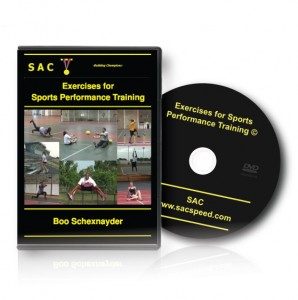
Exercises for Sports Performance Training

Discover Full Circuits & Routines Covering All of Your Speed, Strength, Mobility, Coordination, & Endurance Needs

Click here to learn more


SCIENTIFIC REFERENCES:

#1- Sprinting and Glutes by Bret Contreras: http://bretcontreras.com/sprinting-and-glutes/

#2- NCBI Post: Activity and functions of the human gluteal muscles in walking, running, sprinting, and climbing: http://www.ncbi.nlm.nih.gov/pubmed/24218079

#3- NCBI Post: Changes in muscle activity with increasing running speed: http://www.ncbi.nlm.nih.gov/pubmed/16194986

Filed Under: speed and agility

Motivating Athletes

February 12, 2018 by

As a coach, you strive to find the words that will help your athletes reach their full potential—not only as athletes, but as young adults. Here are a a few brief motivational messages that coaches have used in motivating their athletes to get the most out of their athletic experience.

This article was provided by Coaches Network

In an article in Psychology Today, Meg Selig—author of Changepower! 37 Secrets to Habit Change Success—provides a few brief motivational messages that coaches have used in motivating their athletes to get the most out of their athletic experience.

Do it for love. Selig remembers when well-know figure skating coach Frank Carroll told nervous 18-year-old U.S. skater Gracie Gold the following message when she took the ice for a key performance: “Think about how much you love skating!” And she references a quote from legendary NBA coach Phil Jackson in his book, Eleven Rings: “Focus on something greater than yourself that you love and value, such as your sport or your team.”

Next play. This philosophy is emphasized by Duke University basketball coach Mike Krzyzewski, who prevents players from dwelling on their mistakes.  Selig cites a description by LinkedIn CEO Jeff Weiner, who has adopted the “next play” philosophy, based on Coach K’s beliefs: “(Coach K) yells out ‘next play,’ because he doesn’t want the team lingering too long on what just took place. He doesn’t want them celebrating that incredible alley-oop dunk, and he doesn’t want them lamenting the fact that the opposing team just stole the ball and had a fast break that led to an easy layup. You can take a moment to reflect on what just happened, and you probably should, but you shouldn’t linger too long on it, and then move on to the next play.”

Aim for excellence, not perfection. Selig says this is a great motto for an athlete who gets bogged down by never being able to achieve total perfection. Accepting failures and glitches in one’s program is simply part of the process.

Why not you? Why not us? According to Selig, Seattle Seahawks quarterback Russell Wilson always remembered his father’s question to him, “Why not you?” When he encouraged his Seahawks teammates, he transformed the saying into, “Why not us?”

Create the best possible conditions for success, then let go of the outcome. Selig quotes this statement from Phil Jackson’s Eleven Rings: “I’ve heard echoes of this statement in interviews by Olympians and other successful athletes. Once you’ve prepared mentally and physically for your game, then you are ready to do your best–and your best is the best you can do.”

Cultivate a learning mindset instead of a fixed mindset. Many young athletes believe that it’s talent that counts, says Selig, and as a result, they don’t put in the hard work needed to overcome deficiencies, hone a skill to excellence, or develop the mental strength and flexibility to bounce back from failure.  For these athletes, Selig encourages that the coach rewards effort rather than talent and reframe failure as an opportunity to learn.

Use setbacks as motivation. Can athletes use their failures as a springboard to success? Selig writes, “If you read the sports page, you’ll find that almost every sports team uses a significant loss to motivate themselves to improve in the coming year.”

Keep your self-talk encouraging. Selig emphasizes that positive self-talk must be geared to the athlete’s own and she offers these phrases as mantras for athletes to say to themselves: “I’ve done it before; I can do it again, “or “I’m going to trust myself,” or “Whatever happens, I’ll do my best.”


Do you work with female athletes? Here is a great resource from Coach Dawn Redd-Kelly that will help you motivate female athletes. 

Click here to find out more about Coach Dawn’s eBook: Motivating Female Athletes

Comes with a FREE PowerPoint presentation called Guarantee Your Success: Using John Wooden’s Pyramid of Success To Increase Your Team’s Cohesion.

Filed Under: motivation

Exercises to Increase Vertical Leap and Power

February 10, 2018 by

Increasing vertical leap and power will improve the athletic performance of most athletes. Here is a quick routine that can help improve power and vertical leap.

In this clip Michael Cano, from ONEighty Athletics, shares a sequence of exercises that he uses when training his athletes.

He begins the workout with an explosive movement. In this clip he uses High Pulls, however, you could easily use a clean or snatch instead.

Coach Cano offers  the following coaching tips for executing the High Pull:

  • Legs hip width
  • Hands thumb width from the groove
  • Roll the wrist
  • Set the back
  • Engage the core
  • Load the hips
  • Butt back
  • Shoulders should cover the bar
  • Take a big aggressive jump shrug movement.

To begin this workout he has his athletes do 5 reps of the High Pull. Upon completion of the High Pulls, they immediately do 5 reps of box jumps, followed by another set of 5 High Pulls.

Next he as the athlete do 5 reps of depth jumps.  Here the athlete will drop from one box and the immediately accelerate up on to a second box. Then just as before, the athlete will do another set of 5 high Pulls.

The final exercise is Hurdle Hops (he uses benches in the video). In this exercise, the athlete will begin in a power position and essentially do a tuck jump up over the hurdle while being sure to bring their knees up towards his chest. The athlete should land softly in the power position and pause. Next they should stand up and then return to the power position before executing another hop over the next hurdle. Upon completion of the Hurdle Hops, the athlete will complete 5 reps of High Pulls.

Coach Cano has a ton of resources for coaches and one of those is absolutely FREE. Click the link The Ultimate Speed Training Blueprint to get your copy of the free eBook.

The YouTube video below has audio, so please make sure that your volume is turned up and that you have access to the site. Note some schools block access to YouTube.


Don’t forget to get your free copy of The Ultimate Speed Training Blueprint

Filed Under: strength training

Flex Play

February 7, 2018 by

This article was provided by Training-Conditioning

Great flexibility is an important tool in an athlete’s repertoire. The key to improving it is a more dynamic approach to stretching.

By Allen HedrickAllen Hedrick, MA, CSCS*D, is the Head Strength and Conditioning Coach at Colorado State University-Pueblo. He formerly held the same position at the NSCA’s national headquarters and the U.S. Air Force Academy. He can be reached at: allen.hedrick@yahoo.com.

Flexibility plays a larger role in achieving optimum performance than a lot of football players realize. After all, a slightly longer reach could help a receiver snag a high pass. More flexible hips and hamstrings could mean evading an opponent’s tackle.

There is also another important reason flexibility deserves a lot of attention in football strength and conditioning programs: decreased injury risk. The same flexibility that provides a performance edge over a not-so-flexible opponent also allows a player to walk away uninjured from a play that would result in a strain or pull for a less-flexible player.

Here at Colorado State University-Pueblo, flexibility is a vital part of our football team’s strength and conditioning program. In this article, I will explain how we train flexibility, modify our program based on individual players’ needs, and keep our athletes motivated while taking part in flexibility training.

FLEXIBILITY PRIMER
Defined as the range of motion of a joint or series of joints, flexibility can be improved through various types of stretching that target muscles, ligaments, and tendons. There are a variety of methods that can be used to increase flexibility:

Ballistic stretching involves rapid movements that use momentum to carry the targeted body part(s) through their range of motion until the muscles are stretched to their limits. Because ballistic stretching is performed at high speeds, the rate and degree of stretch, as well as the force applied to induce the stretch, are difficult to control. Once widely used, ballistic stretching is no longer considered a safe method for increasing range of motion because of the potential for injury.

Static stretching is the method most commonly used by individual athletes and teams to increase flexibility. It involves passively moving the joint into a near maximal position and holding the stretch for an extended period of time–usually 15 to 30 seconds. Static stretching appears to work well, though depending on the sport and the athlete, it can take a lot of time to complete a sufficient routine.

Proprioceptive neuromuscular facilitation (PNF) involves a couple of steps and a partner. First, the athlete’s partner slowly moves the targeted muscle into a static stretch, while the athlete keeps the muscle relaxed. While still stretched, the muscle is briefly contracted isometrically against an external force (their partner) sufficient enough to prevent movement in the joint. Then the muscle or joint is taken out of the stretched position for a brief amount of time before the stretch is performed a second time, potentially resulting in greater range of motion. While published studies suggest PNF stretching increases flexibility better than static stretching, some of the techniques are impractical because a partner is often needed.

Dynamic stretching involves sport-specific functional-based exercises that ready the body for activity. In many cases, the actual stretching movements are identical to static stretching movements, but dynamic stretches are preceded and followed by full-body movements. Developing a dynamic flexibility program requires analyzing the movements associated with a sport and developing stretches to enhance flexibility based on those movements.

Dynamic flexibility is more applicable to athletic performance because it more closely duplicates a given sport’s movement requirements. This also means that dynamic stretching can be used to teach or reinforce sport-specific movements.

Another benefit is that the exercises can be made more effective by progressing from a standing position to a walk and then a skip or run. For these reasons, dynamic stretching is the method we employ most with the football team here at CSU-Pueblo.

INSIDE THE PROGRAM
Because dynamic flexibility training is based on the movements that occur in a given sport, the only limiting factor is the creativity of the coach designing a flexibility training program. I have a core group of exercises I like to use with our football players because I have found they best mimic the movements they perform on the field.

All the exercises we use are performed as players walk over a distance of 15 to 20 yards. A routine of five to six movements is performed every day–either in the weightroom prior to strength and power training on Mondays, Wednesdays, and Fridays, or on the football field before we perform speed/agility/conditioning activities on Tuesdays and Thursdays. We also perform static stretching routines to finish our sessions on Tuesdays and Thursdays.

To avoid monotony and make this a fun activity (while still emphasizing good technique) I use different movements each day and mix up the order. This way, the athletes will not dread this portion of their training.

Although all of our football players generally perform the same flexibility stretching routine, we do individualize the program for those who have specific flexibility problems. The large number of athletes on the team keeps us from performing a formal movement screen on each athlete, but athletes with flexibility issues are easily identifiable when participating in our strength and power training program.

For example, an athlete may display limitations when trying to properly rack the bar with a high elbow position when cleaning, or not be able to achieve a full squat position when squatting or catching a full clean. These athletes are prescribed additional flexibility work to perform on their own. The system seems to work well because we put an emphasis on correct technique in the weightroom and our athletes do not like to be singled out in front of teammates as having deficient exercise technique.

We also make it a point to constantly stress to our athletes that it is possible to increase strength and improve flexibility at the same time. For example, deep squats, full range of motion side lunges, and well executed cleans allow for the development of flexibility and strength/power simultaneously. Many football players only think about getting bigger and stronger, so this is a way to get them to take the flexibility work seriously.

OUR EXERCISES
Following is a partial list of dynamic flexibility exercises we use with the football team here at CSU-Pueblo. This is by no means an all-inclusive list, but is a good starting point for a football program.

Lunge walk: While clasping his hands behind his head, the athlete steps forward and drops into a lunge position with his torso leaning back slightly. The back knee hovers just off the ground, where he pauses for a count, then switches to move the opposite leg forward. This exercise can also be completed as a reverse lunge walk, where the athlete moves backwards.

Lunge walk/palms to floor: With his hands at his sides, the athlete steps forward and drops into a lunge position. Here, he places both palms on the floor outside of his front foot with fingers pointing forward. After pausing for a count, he rises and repeats on the opposite leg, progressing forward with each step.

Twisting lunge walk: With his hands clasped behind his head, the athlete steps forward with his right foot and drops into a lunge position. As he drops, he twists his upper body so that his left elbow touches the outside of the right leg. After pausing in this position for a count, he stays down but twists the opposite way so that the right elbow touches the inside of the right leg. He then repeats with his left leg forward, touching the outside of the left leg with the right elbow, then the inside of his left leg with his left elbow, progressing forward with each step. This exercise can also be completed as a reverse twisting lunge walk, where the athlete moves backwards.

Hockey lunge walk: While clasping his hands behind his head, the athlete steps forward, placing his front foot about eight to 10 inches outside of his shoulder, and then drops into a side lunge position. Both feet should be pointing directly forward with the back knee hovering just off the floor, head up, and back slightly arched, just like in a forward-stepping lunge. After pausing for a count in the bottom position, he repeats with the opposite leg, progressing forward with each step.

Walking side lunge: The athlete takes a long lateral step with the right foot, keeping his toes pointed forward. Keeping the left leg straight, he sinks his hips back and to the right in a groin stretch. With his back arched, he pauses for a count at the bottom, then stands back up before pivoting and repeating the movement with the left leg leading.

Lunge out on all fours/walk hands between: The athlete lunges out on all fours, with the body extended long and supported by the hands and feet. Keeping his hands stationary and legs as straight as possible, the athlete walks his feet up between his hands. At the top of the movement, he lunges out on all fours again and repeats the movement, attempting to get his feet further through the hands with each repetition.

Walking knee tuck: Stepping forward with his left leg, the athlete pulls his right knee up to his chest, using his hands to assist. After pausing for a count, he steps with the right leg and pulls the left knee, trying to pull the knee higher with each repetition.

Walking knee tuck/lift the foot: The athlete steps forward with the left leg and pulls his right knee to his chest as if performing the walking knee tuck, but at the top of the movement, he moves his right hand to his right foot, then pulls the foot toward his shoulder while standing tall. After pausing for a count, he steps with the right leg and repeats the pulling action with the left leg.

Walking over/under: Turning sideways, the athlete imagines a series of high and low hurdles progressing down the track. He first swings his right leg and then his left up and over the first high hurdle, keeping his toes pointed forward. After clearing the first high hurdle, the athlete drops into a squat position and moves laterally under the first low hurdle. After moving under the low hurdle, he pivots to the opposite direction and repeats the two movements.

Walking leg swing to opposite hand: The athlete steps forward with his left leg and left hand outstretched. After returning his left leg to the ground, he swings his right leg up to touch his left hand while keeping his right leg straight throughout the swinging motion. He repeats the movements with the opposite leg and hand, attempting to swing the leg slightly higher with each repetition.

Walking knee over hurdle: The athlete imagines a line of intermediate hurdles running down the track, alternating to the right and left sides. Leading with the right knee, he lifts his right leg up and over the first hurdle, placing the right foot down in front of him. He repeats the movement, leading with his left leg and attempting to bring the leg slightly higher over the hurdle with each repetition.

As the athlete becomes proficient at performing each dynamic flexibility movement, the exercises can be “complexed” into combinations. For example, the athlete can perform a knee tuck to a lunge walk, alternating legs after each movement has been performed.

There are two primary advantages of combining movements. First, it becomes a more sport-specific way to train because in football, the athletes do not repeat the same movement often. Second, it becomes a more efficient way to train because a larger number of muscle groups are stretched when performing a combination of stretches rather than duplicating the same stretch repeatedly.

This also shows the wide array of options available with dynamic stretching. Simply use the movements athletes make on the field and you’ll find increased performance during training, and more importantly, during games.

Sidebar: WARMUP VS. STRETCH
It is important to note that a static stretching routine is not a sufficient way to warm up. Because a team stretching routine is a deep-rooted tradition in a lot of sports, some coaches still use it as a warmup. But the truth is, athletes should stretch only after they have warmed up.Warming up is an activity meant to raise body temperature, which readies the body for vigorous exercise. Static stretching is a passive activity, so there is minimal friction of the sliding filaments. There is also little, if any, increase in the rate of fuels being metabolized. Therefore, it’s easy to see that static stretching results in minimal increases in core body temperature.A proper warmup before stretching is necessary because the decreased muscle, tendon, and ligament viscosity that results from an elevated core temperature allows range of motion to increase, which means the athlete will get more benefit from stretching and be at less risk for injury. If their bodies are not properly warmed up, the athletes will feel stiff and be at higher risk for injury.

Filed Under: stretching

What if you Planned Your Day Like You Plan Your Workouts?

February 5, 2018 by

What if you planned your entire day the same way you planned workouts? What if you planned your day so that there was no wasted time and you stayed focused on the things that mattered? The answer is that you would be more productive.

This post was provided by Busy.Coach a site designed to help coaches be more productive

By Mandy Green

I am speaking in a few weeks to all of the amazing coaches who will be at Camp Elevate.  As I am preparing my Time Management 101 speech, I am remembering a conversation that I had with a coach while we were out recruiting a few weeks ago.

It went something like this. “Mandy, I know that I am stressed, overwhelmed, busy doing random stuff all day, and not making the progress I want with my program.   I know I need to manage my time better and get organized, but I don’t even know where to begin.”

My response to this coach was that I believe all coaches need to approach time management in exactly the same way that they approach their practices.

For a typical practice:

  1. Every minute of practice is accounted for and no time is wasted.
  2. Everything is proactively planned in advance and organized.
  3. Top priorities to work on take up the majority of practice and are worked on first.
  4. Tasks have been delegated to other coaches based on their strengths.
  5. There are water breaks in between activities.
  6. Whistles or horns sound when it is time to move onto the next stage of practice
  7. Coaches reflect after practice is done on what went well and what didn’t so they can make tomorrow better.

BUT, for some reason when it comes to getting work done in the office, a lot of coaches just simply go into their office with no plan, react to everything around them, take no scheduled breaks, and choose to do whatever grabs their attention next until it is time to leave the office! Doing things this way is very inefficient and a lot of time is wasted.  And worst of all, no progress is made towards building the program of your dreams!!

The more structure you have during your work time means you get more work done.  It means you get further ahead with your program.  It means you have to work less outside of your work time.

Ok, let’s plan your day in the office tomorrow just like you would plan practice.

When you start planning your day in the office, just like you would when planning practices for your team, make sure to strategically think about and write down what you could do during the day to move your program forward.

  1. Plan everything in advance the day or night before. While there are exceptions to the rule, generally you can’t expect to just show up for practice with no plan of what you are going to do for the day and have it be a good productive practice.  The same holds true for the office.  Write down on a master to-do list all of the tasks you need to get done the next day.
  2. Then decide which of those tasks that need to get done are the most important for moving your program forward and then schedule them into your calendar. Everything else can wait.
  3. Coaches tend to set up their practices by doing their most important drills when they know their team is focused and has the best energy. Do the same for your most important work in the office and you will produce higher quality work in a shorter amount of time.
  4. When a time limit is put on a drill, it creates urgency for coaches so they will work like crazy to get as much productive stuff done with their team in the time allotted. Like you do for your drills at practice, schedule all office tasks in 15, 30, 60, or 90 minute intervals and then keep to the clock.
  5. How much more do you accomplish with your teams when they are paying attention and putting all of their focus and energy into what you are working on in practice?  The same holds true for getting stuff done in the office. The quality of your work declines and the time it takes to get tasks done increases when you not 100% focused on the task at hand.
  6. Avoid multi-tasking. You would never jump from drill to drill as new drills pop into your head.  Once you start working on something in the office, continue to work on only that task until it is finished.

I could go on and on but you get the idea.

For you coach, once your to-do list is organized based on your goals and vision for your program, it becomes a map to guide you from morning to evening in the most effective and efficient way. This guide tells you what you have to do. It also helps you decide what is urgent and what is not, saving you a lot of time.  Time that you might have otherwise wasted on less important busy-work that isn’t necessarily going to move your program forward.


Filed Under: professional develpoment

  • « Previous Page
  • 1
  • …
  • 11
  • 12
  • 13
  • 14
  • 15
  • …
  • 40
  • Next Page »
  • Twitter
  • Facebook
  • linkedin

© Copyright 2025 Athletic Performance Toolbox

Design by BuzzworthyBasketballMarketing.com

Privacy Policy