Athletic Performance Toolbox

  • Strength Training
  • Speed and Agility
  • Administration
  • Injury Prevention/Rehabilitation
  • Professional Development
  • Archives

10 Ways to Give Better Feedback

October 4, 2017 by

This post was syndicated from the Inner Drive blog.

Giving feedback can be a double-edged sword. The Sutton Trustreports that if it is done right, it can be one of the most effective ways to help someone improve their learning; however, research suggeststhat 38% of feedback interventions actually do more harm than good.

What we intend to be encouraging and constructive can easily be interpreted as judgement and criticism. So how can we save ourselves from the pitfalls of giving unhelpful and potentially damaging feedback?


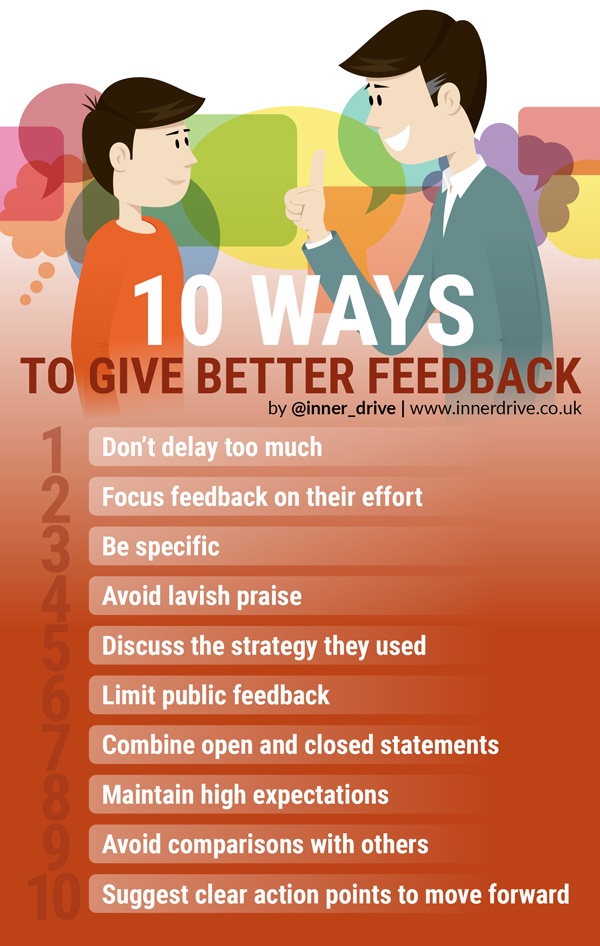
Here are ten tips on how to give better feedback:

Don’t delay too much– An interesting review on when to give feedback found something quite curious. The researchers discovered that in experiments conducted in a laboratory, delayed feedback were more helpful; however, in a real world setting, especially in classrooms, immediate feedback was more beneficial. This makes sense when you think about it: the real world is messy and complicated; leave things too long and things get forgotten; memories get distorted; other pressing events crop up.

It is not always possible or practical to give immediate feedback. This is especially true if emotions are running high. The trick is to give timely feedback in a way that doesn’t smother people (too much too soon can be just as bad), but early enough that the event is still fresh in their mind. As with all things in psychology, there are some caveats to the rules.

Research suggests that in some situations, delaying feedback may actually be better. These may include when the task is simple and when there is plenty of time available (giving the other person enough time to try several different strategies)

Be specific – When you say ‘good’, the assumption is that the person will know exactly what was good. This is not always the case. It is easy for people to misunderstand what you mean. This is especially true when giving feedback to teenagers, who as a result of their brain restructuring, can find it harder to understand someone else’s perspective and thought process. The more detailed and specific the better. This will remove any ambiguity. It is far better to say, ‘The way you did X was really good.’

Focus feedback on their process, not their natural ability– Praising someone’s effort (instead of their intelligence) will help them to develop a growth mindset. This impact has been found in even very young children, with the type of praise given to 1-3 years old impacting on if they have fixed or growth mindset up to 5 years later.

Praising someone’s effort increases their intrinsic motivation and provides a template for them to follow next time. A separate study found that the type of praise children receive actually drives the type of feedback they then seek out themselves post task. In this study, 86% of children who had been praised for their natural ability asked for information about how their peers did on the same task. Only 23% of children who had been praised for effort asked for this type of feedback, with the vast majority of them asking for feedback about how they could do better.

Avoid lavish praise – When someone has repeatedly struggled, it is tempting to heap lots of praise on them when they achieve some level of success, no matter how small. This can actually do more harm than good. Insincere praise is very easy to detect. Too much praise can convey a sense of low expectation and, as a result, be demotivating.

Limit public feedback – Teenagers care a lot about what their peers think of them. Public feedback, even if well intended, can easily be interpreted as a public attack on them and their ability. This can quickly lead to a fear of failure. This can result in teenagers putting on a front, accompanied with bundles of bravado.

A nice way to overcome this is what author Doug Lemov calls ‘Private Individual Correction’. This limits the publicness of the feedback, whilst still getting the message across clearly. This is similar to the technique he calls ‘The Whisper Correction’, which although done in public, the pitch and tone of voice is done to limit everyone else’s attention to the individual feedback.

Combine open and closed statements – A closed question is one where the answer is ‘yes’ or ‘no’ (i.e. ‘Were you nervous before the exam?’). The problem with these questions is that if the answer is no, the conversation can grind to a halt. You may find out that they weren’t nervous, but you won’t find out what they were actively feeling (sad, angry, not bothered, tired etc.). An open question, such as ‘how were you feeling in the morning?’, encourages someone to tell their story.

A combination of open and closed questions and statements can help when it comes to giving feedback. Closed statements help you to convey the information you want and can potentially save time and keep the conversation focused. Open questions allow for a good two-way conversation and can help students develop a sense of ownership of the situation.

Avoid comparisons with others – It is far better to focus your feedback on their individual development and improvement instead of in comparison with others. A recent study found that being positively compared to someone else can lead to narcissistic behaviour. This sort of comparison can also reduce someone’s intrinsic motivation, which has been associated with lower confidence, emotional control, academic performance and increased anxiety.

Discuss the strategy they used – This can help them identify helpful thought processes so that they can do the same again next time. Psychologists call this ‘metacognition’. Put simply, metacognition is the awareness and control of your thought process. This is a very valuable skill and has been found to significantly help students improve their grades.

Maintain high expectations – A famous study, conducted almost fifty years ago, found that high expectations can have a powerful effect. Teachers were falsely told that some of their students had been identified as potential high achievers; they were expected to bloom over the course of the year. Several months later, when compared to the rest of their classmates, these students had in fact made significantly more progress. What drove this change? The teachers’ increased expectation for these students.

This is known as the Pygmalion Effect (named after the mythical Greek sculptor who loved his statue so much that it actually came to life). Have high standards and people will often up their game in order to match them. Sometimes students need someone to believe in them before they can believe in themselves.

Suggest clear action points to move forward – This is one of the key points from the ‘What Makes Great Teaching Report’. Feedback that doesn’t lead to behaviour change is redundant. There must be a point to it. What do you want them to do differently? What are they going to do after this conversation to improve? The more detailed and specific the action points the better.

FINAL THOUGHT

Giving feedback isn’t easy. If done right, however, it has the ability to transform someone’s learning and performance. If done wrong, it can actually do more harm than good. So don’t delay, focus on their effort, be specific, avoid lavish praise, limit public feedback, use both open and closed questions,  avoid comparisons with others, and suggest clear action points moving forward.

This article was first published on The Guardian website on 10.11.16. You can read it, alongside all of our other Guardian blogs here: https://www.theguardian.com/profile/bradley-busch


About Inner Drive

InnerDrive is a mental skills training company covering the traditional areas of sports psychology and mindset training.

Their work covers the traditional areas of performance psychology, sports psychology and neuroscience. They work with over 120 schools in England and last year worked with over 25,000 students, teachers and parents.

The company is led by Edward Watson, a retired Army major and Bradley Busch, a HCPC registered psychologist.

Filed Under: professional develpoment

Muscle Collagen Synthesis

October 3, 2017 by

By Chris Beardsley

Chris Beardsley  graduated from Durham University with a Masters Degree in 2001. He since contributed to the fields of sports science and sports medicine by working alongside researchers from Team GB boxing, the School of Sport and Recreation at Auckland University of Technology, the Faculty of Sport at the University of Ljubljana, the Department of Sport at Staffordshire University, and the College of Health Solutions at Arizona State University. He is also a Director at Strength and Conditioning Research Limited 

For more great information regarding strength and conditioning follow Chris on Twitter and Instagram

Muscles are made up of individual muscle fibers, which are arranged into bundles of muscle fibers, called fascicles.

Each muscle fiber is surrounded by a layer of connective tissue made up of collagen proteins, called the endomysium. Muscle fascicles are surrounded by a layer called the perimysium, and the muscle itself is surrounded by a layer known as the epimysium.

Together, these collagen layers are known as the extracellular matrix (ECM) of the muscle. They provide support for the muscle fibers and muscle fascicles, and are also involved in the transmission of forces.

The endomysium, which surrounds single muscle fibers, is particularly important for force transmission. When muscle fibers contract, they transmit force laterally through structures that connect their basement membranes to the endomysium. The endomysium then transmits force laterally into the rest of the muscle and longitudinally to the tendon.

Since the ECM functions to provide support for the muscle, the collagen content of it should increase as muscle fibers increase in size after strength training. This suggests that we should observe an increase in collagen protein synthesis alongside the increase in muscle protein synthesis after a strength training workout.

And indeed, that is what happens.

As you can see from the above infographic, when matched for work done, eccentric and concentric training increase collagen protein synthesis similarly after strength training.

Since concentric training does not tend to cause very much muscle damage, this supports the idea that the post-workout increase in collagen content is mainly used for adapting the muscle structure in order to accommodate changes in muscle fiber size.

Even so, eccentric training leads to greater collagen protein synthesis than concentric training when using the same number of sets and reps (volume) and not the same work done, as you can see from the following infographic.

Together, these findings suggest that there is a dose-response effect for the increase in collagen content after strength training, such that greater work done leads to greater increases.

And interestingly, this further supports the idea that the collagen is being used to restructure the muscle to accommodate the greater muscle fiber size, because muscles also increase to a greater extent with higher training volumes.

It must be admitted that until recently, there was little evidence for increases in collagen content within a muscle after long-term strength training.

In the last few months however, it was discovered that a standard strength training program could produce increases in type IV collagen within the endomysium of human muscle fibers, and also displayed trends for increases in types I, VI, and XII.

As well as providing a larger structure for a larger muscle fiber, the increased collagen content of the endomysium could also increase muscle stiffness (which is a common adaptation to strength training).

In addition, it has been suggested that the increased collagen content in the endomysium could make the muscle more able to store elastic energy, potentially protecting it from future strain injury. However, this is still speculative, and we are still a long way away from understanding the interactions between increased collagen content, increased collagen cross-links, and changes in the lateral connections between the muscle fiber and the endomysium after various types of strength training.

Filed Under: strength training

Renegade Rows

September 30, 2017 by

This article was provided by Training and Conditioning

When planning an athlete’s workout, most coaches try to find exercises that engage multiple muscle groups and more efficiently use weight room time. If you’re looking for a compound exercise that will fill many needs, the Renegade Row might be the perfect option as it works the core as well as the upper body.

In an article for Stack.com, Andy Haley, CSCS, explains that as an anti-extension core exercise, the Renegade Row is safer for your athletes than other similar movements. It reduces the chance of injury by training the athletes’ abs and other core muscles to prevent the lower back from extending.

“As soon as you lift a dumbbell off the ground, the exercise gets much more intense,” writes Haley. “It pulls down your shoulder, and your opposite hip wants to shoot up into the air to make it easier on your core.

“To perform the exercise properly in the plank position with your hips level and square to the ground, your core muscles work to keep you in the exact same position as when both dumbbells are on the ground—but now you only have one arm for support,” he continues. “In addition to the anti-extension component discussed above, it also works anti-rotation, meaning your core muscles prevent your torso from rotating.”

While the core is working, so are the shoulders, back, chest, hips, and quads. Each of these muscle groups are utilized and strengthened while helping your athlete stay in the right position throughout the exercise. The unilateral nature of this exercise in strengthening each of these components makes it a useful workout for athletes in any sport.

“This exercise is particularly beneficial for athletes, or anyone, for that matter, because we rarely ever work with both arms and legs at the same time in sports or everyday life,” writes Haley. “There’s usually some sort of asymmetrical force or movement, such as what occurs when you throw a ball, push off against someone with one hand or even open a heavy door.”

While the Renegade Row can be very beneficial to athletes, it can also be harmful if done incorrectly. In an article for the National Federation of Professional Trainers, Ian Nimblett, CFCS, CSCS, CPT, recommends that athletes be able to master the regular plank for 60 seconds before moving on to this type of exercise. He then lays out the steps to completing it correctly:

  1. Hold a dumbbell or kettlebell in each hand and get into pushup position, balancing on the handles.
  2. Shift your body weight to your right side so your left arm feels light.
  3. Row the left-hand dumbbell to your ribs, bring back down to the starting position, and repeat.
  4. Keep your body in a straight line and your abs braced throughout. Do not move your hips.
  5. Repeat on the opposite side of your body.

If your athlete is struggling to do this exercise, Nimblett suggests moving the feet into a wider stance, which gives a more stable base. Once the athlete begins to build strength and becomes more used to the exercise, the feet can be gradually brought back together. However, make sure that while this change is being made their body stays in alignment throughout.

When implementing this exercise into your athlete’s workout, it is important to not overdo it. Haley suggests starting with a lighter weight, and gradually moving up as strength increases. He also recommends not utilizing the Renegade Row too often. Instead, integrate it one or two times per week into the core workout, with 3-4 sets of 5 reps on each side. Nimblett echoes this sentiment, suggesting that athletes focus on quality repetitions over quantity.

To see the Renegade Row in action, check out this YouTube video from Nimblett. The video has audio, so please make sure that your sound is turned on.

Filed Under: strength training

Push-Up Complex

September 29, 2017 by

This article was provided by Coaches Network

There’s nothing fancy about push-ups. They can be done anywhere by any athlete with no equipment or complex instructions. That may be the reason they are sometimes overlooked in a training program. However, they should be perfected by all athletes and then used as a starting point for progress.

According to a blog by Ryan J. Faer, CSCS, former Director of Strength & Conditioning at DeLand (Fla.) High School, the push-up can be made into much more than an entry-level exercise. The positioning of an athlete during push-ups allows easy transitions into other movements, creating what Faer calls a push-up complex.

“The hands and feet position (the High Plank) puts the athlete in a great set-up to execute a variety of movements to accomplish many different training goals,” he writes. “And, string movements in succession and you will yield a physical challenge to the whole system as well – much more challenging than the traditional Push-Up

The number of exercises that can be used in a push-up complex is almost endless, and depends on what you want your athletes to focus on: mobility, stability, or posture. Here is an example of a complex from Faer:

  • Begin in push up position.
  • Push Up x1
  • Shoulder Taps x1 each (Stability)
    • In push up position raise left hand and tap right shoulder.
    • Return hand to ground.
    • Raise right hand and tap left shoulder.
    • Return hand to ground.
  • Leg Lifts x1 (Stability)
    • Raise right leg almost parallel to ground.
    • Return to ground.
    • Raise left leg almost parallel to ground.
    • Return to ground.
  • Downward Dog x1 (Mobility)
    • Keep hands and feet in place.
    • Push backwards, hips rising until you create a triangle with the ground, heels almost touching the ground.
  • Return to push-up position and repeat from the beginning.

With any push-up complex, each movement should flow straight into the next. Faer suggests going through all of the motions five times without stopping, and counting this as one set. He recommends athletes do three sets, but continuously change the chosen movements or amount of repetitions depending on the athlete’s ability level.

“One set may only require 5 push-ups, but the result is a strenuous complex or flow that challenges shoulder and trunk stability, hip mobility, posture, and hamstring flexibility,” he writes. “Not challenging enough? Simply make each Push-Up x 2 (10 push-ups per set) or x 3 (15 per set)… you get the idea. Or, you can add more movements to challenge other aspects of mobility, stability, or posture.”

No matter what movements you choose, one major benefit of the complex is that it constantly strengthens posture.

“What’s great is that, by simply reinforcing the importance of the High Plank position and reminding the athlete to move consciously and with purpose, posture is greatly emphasized in every Push-Up Complex,” writes Faer. “That is because every time we leave the High Plank position, we must eventually return to it and re-establish proper alignment, thus getting great kinesthetic exposure each set.”

Another benefit of the push-up complex is efficiency. Because your athlete is going through multiple motions, they are engaging various areas of their body all within one exercise. This also adds variety and keeps athletes from becoming bored by the monotony of regular push-ups.

To see the above complex in action, check out this video from Faer.

The YouTube video does not have audio. Click the arrow to play. Note some schools block access to YouTube.

Filed Under: strength training

Jump Drills

September 22, 2017 by

Enhance the speed and agility component of your training and conditioning program with these simple jump drills and coaching points.

In the video clip below  Steven Kenyon, former National Strength and Conditioning Coach of the Year and founder of Speed Strength Training, presents Jump Drills as part of his 10 Speed and Agility Weightroom Drills presentation at a recent Glazier Athletic Performance Clinic.

Coach Keynon shares his thoughts on the advantages of these exercises and provides key coaching points so that the athletes will get maximum benefits of each exercise.

Here are the jumps covered in this clip:

  • Tuck Jumps
  • Stick Jumps
  • Multiple Hurdle Jumps
  • Depth Jumps

For information about gaining access to Coach Kenyon’s complete presentation, as well as hundreds of other great athletic performance clinic presentations, click the link Glazier Athletic Performance Clinics The clip below has audio, so please make sure that your sound is turned on. Click the arrow to play the video.


Filed Under: Injury prevention, speed and agility

  • « Previous Page
  • 1
  • …
  • 18
  • 19
  • 20
  • 21
  • 22
  • …
  • 40
  • Next Page »
  • Twitter
  • Facebook
  • linkedin

© Copyright 2025 Athletic Performance Toolbox

Design by BuzzworthyBasketballMarketing.com

Privacy Policy